

When we tell people what Simple Proof does — anchor digital records to the Bitcoin blockchain so they can never be quietly altered — the most common follow-up question isn't how. It's why Bitcoin?
Why not projects like Ethereum? Solana? Why not a "private blockchain" that a consortium of trusted parties operates? Why not just timestamp things with a regular notary, or a certificate authority, or just use Microsoft?
It's a fair question. And the answer matters more than the technical details, because if you don't understand why Bitcoin is the foundation we chose, the integrity guarantees we offer will sound like marketing.
So let's start somewhere unexpected: with a problem that has nothing to do with cryptocurrency.
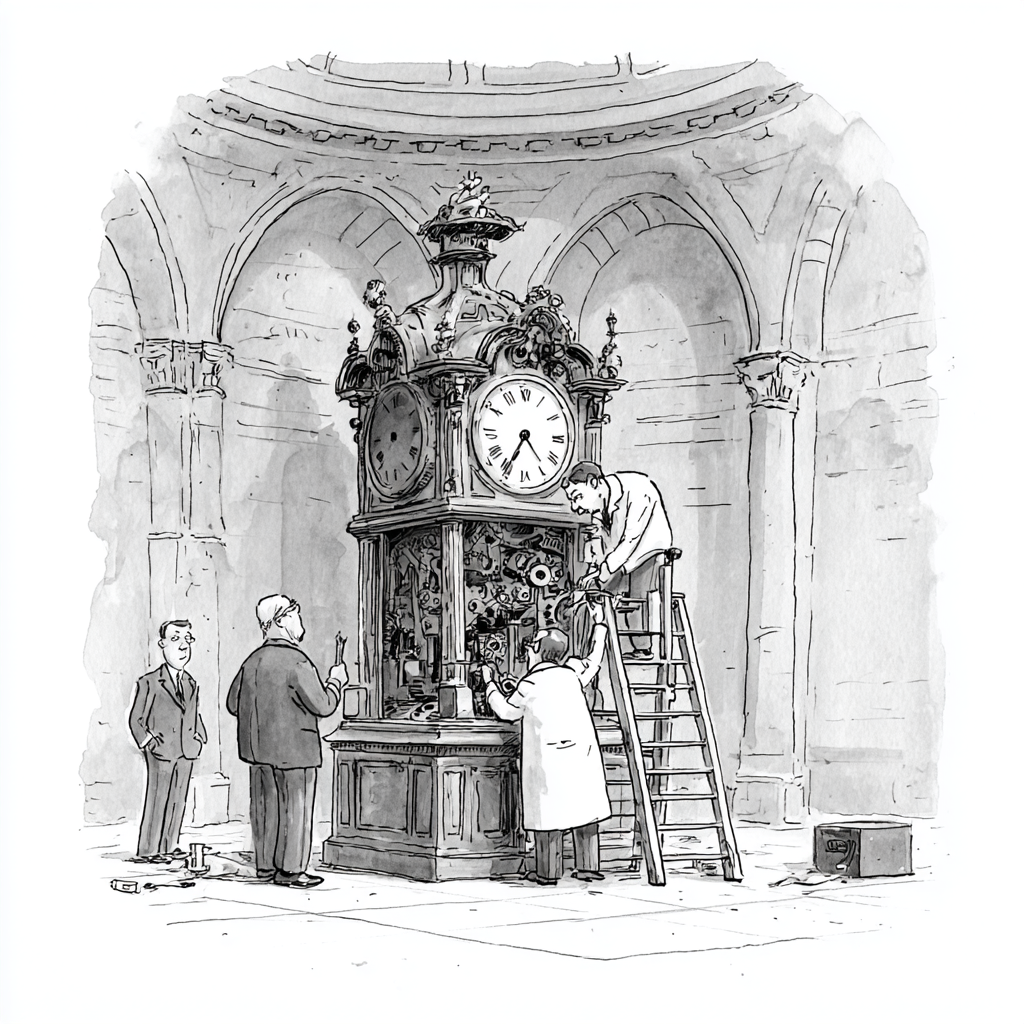
Every digital system that needs to know something about the outside world faces the same problem. A smart contract that pays out based on a sports result needs to know who won. An insurance system that pays out for a flight delay needs to know whether the flight was delayed. A timestamping system needs to know what time it is.
In computer science, these "bridges to reality" are called oracles. And oracles are notoriously, structurally hard to get right.
Consider Polymarket, the prediction market platform. Polymarket lets users bet on real-world events, and when an event resolves, an oracle determines the outcome and the platform pays out the winners. Sounds simple. But in practice, Polymarket has had to deal with disputed resolutions, oracle manipulation attempts, and edge cases where reasonable people disagreed about what actually happened. In some cases, large bettors have had financial incentive to influence the oracle's reading of reality.
This isn't a Polymarket problem. It's an oracle problem. Whenever a digital system has to ask "what's true out there?", whoever answers that question becomes a single point of failure. They can be wrong. They can be bribed. They can be coerced. They can be hacked. They can simply disappear. Or they can be manipulated using a lighter or a hair dryer. In April 2026, French police opened an investigation after a Polymarket trader bet $119 that Paris would exceed a specific temperature on a given day, then reportedly profited over $21,000 when an isolated temperature spike was recorded at the Charles de Gaulle Airport weather station — a spike that no nearby station registered. Investigators concluded he had manipulated the sensor — possibly with something as crude as a hair dryer.
Certificate authorities — the institutions that vouch for whether a website is really what it claims to be — have been compromised repeatedly (the 2011 DigiNotar breach, in which an attacker issued a fraudulent wildcard certificate for google.com and used it to intercept the traffic of hundreds of thousands of Iranian citizens, is only the most infamous in a long list), both by attackers and by governments. The companies that run digital timestamping services can go out of business, taking the verifiability of their timestamps with them. Network Time Protocol servers, which most computers in the world rely on to know what time it is, have been spoofed in attacks demonstrated by academic researchers — including a 2015 Boston University study showing how an on-path attacker can quietly shift the time on client systems backwards or forwards, undermining anything that relies on accurate timestamps for security.
Trust, when concentrated in one place, is a vulnerability dressed up as a convenience.

Of all the things an oracle might tell you, time is uniquely important. Because almost every other claim about reality depends on it.
Did this document exist before that lawsuit was filed? Did this video footage capture something that happened before or after the alleged crime? Did this election result get certified before any tampering could occur? Did this contract get signed before the deadline?
Strip the timestamp away from any record, and the record becomes nearly useless. A photograph of a meeting tells you nothing if you can't establish when the photograph was taken. A signed agreement is meaningless if either party can quietly backdate their copy. Surveillance video of a crime that cannot be matched, beyond a reasonable doubt, to the moment it occurred can be thrown out in court.
This is why timestamping is foundational to law, accounting, journalism, science, and governance. And it's why, in the digital age, who controls time is one of the most important and least-discussed questions in computing.
When a certificate authority issues a timestamp, you're trusting that authority's clock — and trusting that no one inside the authority has reason to lie. When a notary stamps a document, you're trusting the notary. When Google (or any cloud services provider) records a file's creation time, you're trusting that system.
For most everyday purposes, that trust is fine. But "most everyday purposes" is not the standard institutions should be held to when the stakes are high. Election records, surveillance footage, financial audit trails, evidence in criminal cases — these need a clock that no one can lean on.

Before Simple Proof, I spent several years working on Oracle Database projects, and when I started paying serious attention to Bitcoin I was researching distributed databases — Cassandra in particular — and wrestling with the CAP theorem, the proof that you can't have perfect consistency, availability, and partition tolerance in a distributed system all at once. That's the wall every distributed database eventually hits. Then I looked at Bitcoin, and it clicked: this isn't a database trying to solve consistency. It's something stranger… it's a decentralized clock.
Bitcoin solved a problem that computer scientists had been working on for decades: how do you get a globally distributed network of mutually distrustful participants to agree on the order of events, without anyone being in charge?
About every ten minutes, the Bitcoin network produces a block. Each block contains a cryptographic reference to the block before it, forming an unbroken chain stretching back to January 2009. The order of these blocks is established not by anyone's clock, but by a global competition that requires participants to expend real-world energy to participate. The result is a sequence of moments in time — block 1, block 2, block 870,032 — an order that everyone in the world can agree on, and that no one can rewrite without redoing all the work that went into building the chain.
This is what we mean when we say Bitcoin is a "decentralized clock." It's not measuring time in the way a wristwatch does. It establishes a universally agreed-upon ordering of events, anchored to physical reality through proof-of-work, and maintained by a network distributed across every continent on Earth.
Anchor a piece of data to block 870,032, and you've made a claim that no human authority can revoke: this data existed before this moment. Verifying that claim doesn't require trusting Simple Proof, or trusting an AI, or trusting any government. It requires only the ability to read the Bitcoin blockchain — which anyone with an internet connection can do, forever.
It's worth pausing on why this works at all. Bitcoin can serve as a clock no one controls because of a feedback loop between two of its properties. The proof-of-work mechanism — miners competing to extend the chain — is what produces a tamper-resistant ordering of events. That same mechanism is what makes Bitcoin scarce, and therefore valuable as money. And the value of the money is what pays the miners to keep competing. The clock secures the money, and the money secures the clock. Break either side and the whole system stops working.
The economic incentive is what does the heavy lifting. Miners around the world do real work (in the thermodynamic sense), expend capital, and compete continuously to extend the chain because the system pays them in something the world has decided is valuable. That valuation isn't decorative — it's the moat. As of this writing, Bitcoin's market value sits above a trillion dollars, and that value is precisely what makes attacking the network's history economically irrational. To rewrite Bitcoin's past, you would need to outpace the entire network's computing power long enough to overtake the existing chain. The same property that makes Bitcoin work as savings is what makes it work as a clock.
.png)
This isn't a niche view held only by Bitcoiners. Serious institutions are starting to take Bitcoin's underlying computer science seriously — and for the same reasons. On April 21, 2026, U.S. Indo-Pacific Commander Admiral Samuel Paparo told the Senate Armed Services Committee that the military's interest in Bitcoin is "as a tool of cryptography, a blockchain, and reusable proof of work as an additional tool to secure networks and project power," and confirmed that INDOPACOM is operating a Bitcoin node for that purpose. Nine days later, Secretary of War Pete Hegseth confirmed to the House Armed Services Committee that the Department views Bitcoin as a strategic asset and that classified Department of War efforts involving Bitcoin are underway. None of this is about price speculation. It's a recognition that a globally neutral, computationally anchored network is something a serious institution may want to be able to rely on.
A more unexpected signal points the same way. In March 2026, the Bitcoin Policy Institute released a study testing 36 frontier AI models from six providers across more than 9,000 neutral monetary scenarios. Bitcoin came out as the top choice in 48.3% of responses, and dominated the "store of value" category at 79.1%. Not a single model — out of 36 — chose traditional fiat as its top preference. AI systems, optimizing without ideology, repeatedly converge on the same answer when asked to reason about preserving value over time. The reasons that lead a machine to that conclusion are the same reasons that make Bitcoin the right substrate for preserving anything that needs to last.
This is the question we get most often, and it deserves a direct answer.
There are thousands of blockchains in existence. Most of them will not be here in ten years and many from ten years ago are now gone. Many of them are controlled by small teams of developers who change the rules, roll back transactions, and shut the network down if sufficiently motivated — or sufficiently pressured. Many of them rely on a small number of validators whose identities are known and whose computers could be seized. Many of them have experienced contentious "hard forks" where the official history of the chain was rewritten because powerful stakeholders preferred a different version.
Bitcoin is different in ways that matter specifically for the use case of preserving historical records:
When we evaluate Bitcoin against the alternatives for our specific purpose — preserving the integrity of records that need to be verifiable decades from now — nothing else comes close. We're not religiously committed to Bitcoin. We're committed to giving our customers the strongest guarantee available.
Today, and for the foreseeable future, that guarantee is built on Bitcoin. If something better comes along, we'll evaluate it on the merits. But "better" has to mean better at this specific job, not faster, cheaper, or more featureful. When you're protecting the historical record, boring properties — durability, neutrality, predictability, longevity — are the ones that matter. If you can have the greatest security on earth, why settle for less? If the greatest security is comparable in cost to alternatives, making the wrong choice becomes a liability.

When Screven County, Georgia anchored their election certification documents to block 870,032 of the Bitcoin blockchain, they didn't just check a box on a vendor evaluation. They made a decision about who they trusted with the integrity of their election records — and the answer was: no one in particular.
Not Simple Proof. Not Facebook. Not the federal government. Not any single company that might be acquired, go bankrupt, or be coerced. They anchored their records to a system whose entire design ensures that no one, including its own creators, can selectively edit the past.
That's the practical promise. And it's why, when someone asks us "why Bitcoin?", our answer isn't ideological. It's the same answer any responsible institution should give when asked why it chose its critical infrastructure: because it's the most reliable option available, by a margin that isn't close.
The records we help institutions protect — election results, government documents, surveillance footage, audit trails — are exactly the kind of data that adversaries have always wanted to alter. For most of history, they've been able to. The combination of cryptographic timestamping and Bitcoin's decentralized clock changes that equation, possibly for good.
That's worth choosing carefully. And we have.
Bobby Allyn, "French police probe suspected weather device tampering after odd Polymarket bet," NPR, April 23, 2026.
npr.org
SSLMate, "Timeline of Certificate Authority Failures." A reference list of documented CA compromises, including the 2011 DigiNotar breach. sslmate.com/resources/certificate_authority_failures
Aanchal Malhotra, Isaac E. Cohen, Erik Brakke, and Sharon Goldberg, "Attacking the Network Time Protocol," Boston University, 2015. eprint.iacr.org/2015/1020
Office of Congressman Lance Gooden, "Gooden Reveals Historic U.S. Military Use of Bitcoin Node," April 2026. https://gooden.house.gov/2026/4/gooden-reveals-historic-u-s-military-use-of-bitcoin-node
Office of Congressman Lance Gooden, "Hegseth Confirms Bitcoin as Strategic Asset, Gooden Reveals," April 2026. gooden.house.gov
Bitcoin Policy Institute, "Indo-Pacific Commander Calls Bitcoin A Tool For U.S. 'Power Projection' In Senate Testimony," April 21, 2026. btcpolicy.org
Bitcoin Policy Institute, "Study: AI Models Overwhelmingly Prefer Bitcoin and Digital-Native Money Over Traditional Fiat," March 3, 2026. Full study at moneyforai.org.
OpenTimestamps protocol documentation. The open-source standard used by Simple Proof for anchoring document hashes to the Bitcoin blockchain. opentimestamps.org
Simple Proof, "Screven County, Georgia Case Study: Securing Democracy with Bitcoin."
Bitcoin network uptime since inception: Bitbo.io/uptime


