

Imagine a world where every second of a surveillance camera feed is cryptographically sealed the moment it's recorded. Where footage from a city intersection, a government building, or a jail cell carries built-in mathematical proof of exactly when it was captured — and whether even a single frame has been altered since.
Now imagine that this proof doesn't depend on any single company, government, or institution to maintain it. It's anchored to the most secure, decentralized computing network ever created. No one can tamper with it. No one can erase it. No one can rewrite what happened.
This isn't a thought experiment. It's working technology. And it changes the fundamental equation of trust in digital records.
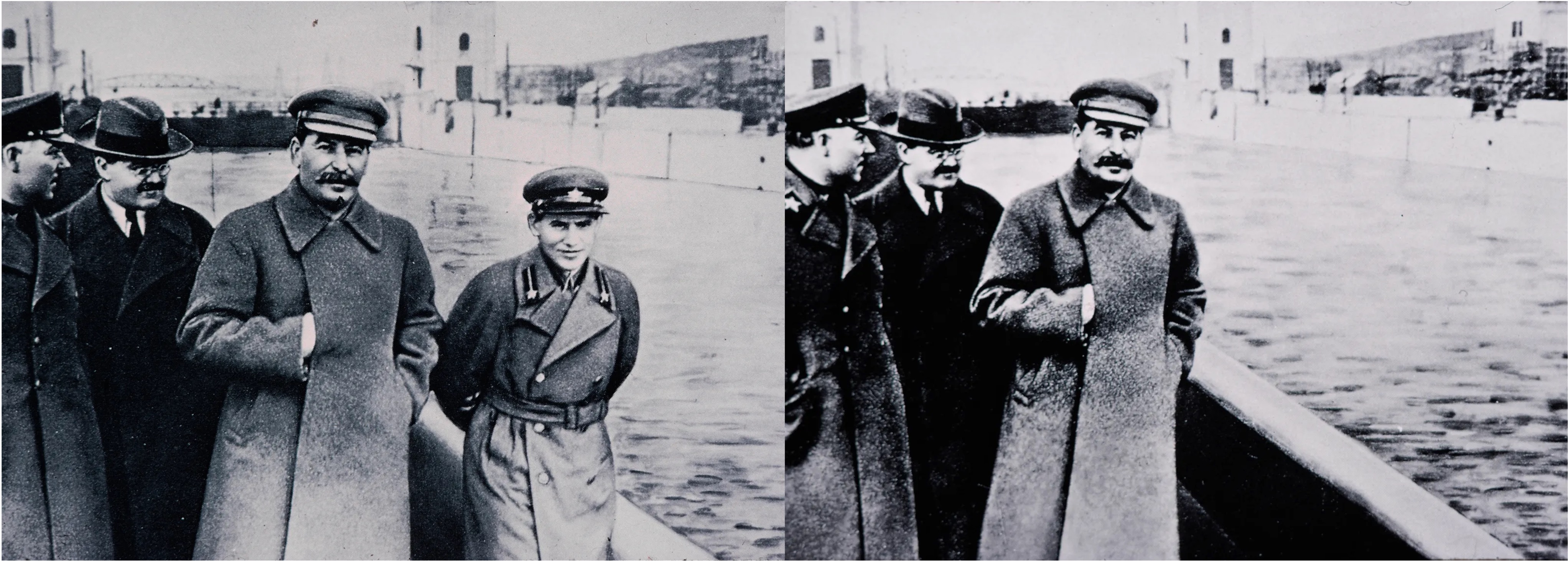
Altering the past is not a new problem. For example, when someone fell out of favor with the Soviet regime, they would get wiped from history.
Source: https://www.hoover.org/research/inside-stalins-darkroom
We live in an era where digital records can be altered without leaving a trace. A video file can be edited frame by frame. A database entry can be rewritten. A government document can be modified and re-dated. The tools to do this are widely available, increasingly sophisticated, and — with the rise of generative AI — getting better every day.
This isn't hypothetical. Deepfake technology has advanced to the point where researchers estimate the vast majority of synthetic media is now used for misinformation and fraud. Courts around the world are grappling with a new reality: digital evidence that looks authentic may not be. The burden of proving that a recording hasn't been tampered with is falling squarely on whoever presents it.
But the problem goes deeper than courtrooms. When digital records can be quietly altered, the incentive structure of institutional accountability breaks down. If surveillance footage can be edited before an investigation begins, the footage loses its purpose.
If public records can be silently modified, transparency becomes meaningless. If data integrity depends entirely on trusting the people who control the servers, then integrity has a single point of failure.
The uncomfortable truth is this: in a purely digital world, the ability to alter the past is the ability to control the present.
This isn't a new fear. George Orwell described it with chilling clarity decades ago. What's new is that the tools to do it are now trivially accessible, and the tools to detect it are locked in an arms race they may not win.
Detection is necessary. But it's not sufficient. What we actually need is prevention — a way to make alteration mathematically provable by anyone, not just forensically detectable by experts.
The concept of a timestamp is simple: it's proof that a piece of data existed in a specific state at a specific point in time. Notaries have been doing this with physical documents for centuries. In the digital world, the equivalent is a cryptographic hash — a unique mathematical fingerprint of a file — anchored to a time-stamped record that can't be changed after the fact.
The question is: anchored to what?
Traditional digital timestamps rely on certificate authorities — centralized entities that vouch for the time and integrity of a record. This works, until the authority itself is compromised, coerced, or simply makes a mistake. It's trust layered on top of trust, all the way down.
.svg)
"It's turtles all the way down."
Bitcoin changed this equation. When a cryptographic hash is embedded in the Bitcoin blockchain, it's secured by the same proof-of-work mechanism that protects trillions of dollars in value. It can't be altered without harnessing more specialized computing power than any entity has ever assembled. The timestamp doesn't depend on trusting any company, any government, or any single point of failure. It depends on math.
The OpenTimestamps protocol, which has been in production for nearly a decade, makes this process efficient and scalable. Rather than requiring a separate Bitcoin transaction for every file, it aggregates thousands of timestamps into a single transaction using a Merkle tree structure. The result: any file can be timestamped on the Bitcoin blockchain and the proof can be independently verified by anyone with access to a Bitcoin node.
At Simple Proof, we've spent the past three years turning this protocol into practical solutions for institutions that can't afford to have their records questioned. We've worked with governments, election authorities, and public agencies to timestamp documents, certifications, and official records — creating an unbroken chain of integrity that anyone can audit.
But until now, there's been a limitation: you could only timestamp files that already existed. A document, a PDF, a signed contract — you'd create the file, then timestamp it. The proof begins at the moment of stamping.
What about data that's still being created?
This is the breakthrough we've been building toward. We call the concept rolling timestamps — the ability to continuously timestamp streaming data as it's being generated, not after the fact.
Here's how it works in practice: as a video stream flows from a camera, the system continuously computes cryptographic hashes at regular intervals — every few seconds, or at whatever frequency the use case demands. Each hash captures the state of the video up to that exact moment. These hashes are then submitted to the Bitcoin blockchain through the OpenTimestamps protocol, creating an unbroken chain of proofs that correspond to specific points in the video's timeline.
The result is a companion file — an OTS Log — that runs alongside the video. From this log, you can extract a specific proof corresponding to any moment in the stream: a particular byte position, a Unix timestamp, a specific frame, etc. If even a single bit of the video is altered after the fact, the hash won't match, and the tampering becomes mathematically provable.
This isn't a watermark that can be stripped. It's not metadata that can be edited. It's a cryptographic commitment anchored to the most immutable ledger in existence.
You can see this working right now at rolling.simpleproof.com. The demo shows a live video feed alongside the rolling timestamps being generated in real time. Each entry in the OTS Log represents a cryptographic snapshot of the video at that exact moment, ready to be verified against the Bitcoin blockchain.
.png)
Simple Proof's rolling timestamp for video demo: every few seconds, a new cryptographic proof is generated and sent to the Bitcoin blockchain as the video is streamed. Visit rolling.simpleproof.com
The timing of this technology isn't coincidental. Several converging forces make rolling timestamps not just useful, but urgent:
While video surveillance is the most vivid application, rolling timestamps work for any streaming data. Security logs, IoT sensor feeds, financial transaction records, scientific instrument data — anything that's generated continuously and needs provable integrity.
Consider a data center monitoring its own infrastructure. Every access log, every temperature reading, every network event can be continuously timestamped. If an incident occurs, the logs carry built-in proof that they haven't been altered retroactively to cover someone's tracks.
Or consider election systems. We've already worked with election authorities to timestamp official results on the Bitcoin blockchain — proving that published outcomes haven't been altered after the fact. Rolling timestamps could take this further, providing continuous integrity verification of the audit logs and tabulation records that election management systems generate throughout the counting process.
The pattern is the same everywhere: wherever data integrity matters, and wherever the people controlling the data shouldn't be the only ones who can verify it, rolling timestamps provide an answer.
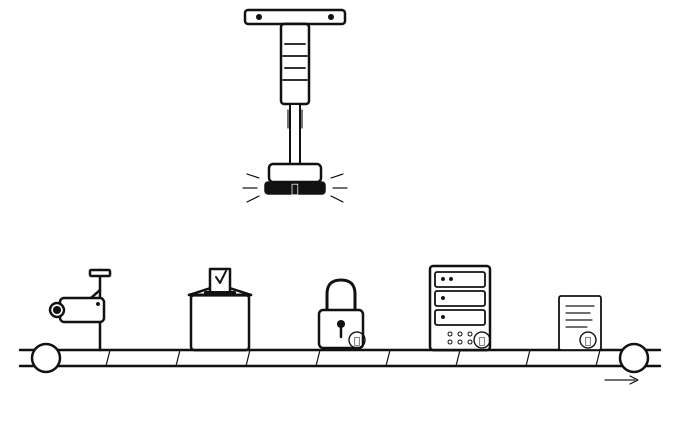
All digital information should be timestamped in an immutable manner. For example: documents, data, secrets, voting records, surveillance footage... as it happens.
We're not the only ones who see the urgency. Governments around the world are beginning to recognize that digital record integrity is a national security issue, a public trust issue, and a practical governance issue.
We're actively working with public institutions in multiple countries to deploy these solutions. The conversations have moved well beyond theory — they're about procurement timelines, integration requirements, and deployment schedules.
The technology is ready. The protocol is open. The need is obvious. What's been missing is the bridge between the cryptographic infrastructure and the institutions that need it most.
That's what Simple Proof builds.
For most of human history, the victors wrote the record. Documents were burned, archives were sealed, testimony was suppressed. In the digital age, the mechanics changed but the vulnerability remained: whoever controls the servers controls the past.
We believe that's ending. Not because people in power have suddenly become more honest — but because a mathematical tool now exists that makes altering records provable, regardless of who holds the data.
Rolling timestamps are the next step in that progression. They extend the guarantee from files that already exist to data that's still being created. They make it possible to protect the integrity of a video stream, a security log, or a sensor feed from the very first byte.
The past should be a matter of record, not a matter of convenience. If you're an institution that holds data the public depends on, the question isn't whether you'll need this technology. It's whether you'll adopt it before your credibility is tested.


